
In the context of industrial flexographic printing, pressure control is one of the most critical elements to ensure constant quality, reduction of waste and production efficiency. Although it is often underestimated, the way pressure is handled between clichés, anilox and print support has a direct impact on the final result and overall profitability of the process.
With the evolution of flexographic presses, the move from manual control to automatic pressure control is no longer a simple technological innovation, but an operational necessity for companies handling complex production runs, variable materials, and increasingly demanding schedules.
Because pressure is a critical factor in flexographic printing
In flexographic printing, pressure is not used simply “to make the machine print,” but to transfer ink correctly. Excessive or insufficient pressure can immediately affect quality, productivity, and costs.
Among the most common consequences of poor pressure management are:
dot gain and print-point crushing,
loss of graphic definition,
color variations,
increased start-up waste,
premature wear of clichés and anilox rollers.
In an industrial context, even small pressure variations can multiply across thousands of printed meters, turning into significant economic inefficiencies.
Limits of manual pressure control
Manual pressure control, historically entrusted to the experience of the operator, has obvious structural limits. The most experienced operator also works on:
regolazioni empiriche,
percezioni visive e tattili,
adattamenti progressivi durante l’avviamento.
Questo approccio comporta inevitabilmente:
longer setup times,
maggiore dipendenza dal singolo operatore,
difficulty in replicating identical printing conditions on subsequent works,
variability of the result between different shifts.
In a market that requires repeatability, standardization and speed, manual control becomes a bottleneck.

The automatic pressure control flexographic presses is a system that allows to manage in a precise, measurable and repeatable way the contact between the different print elements, without relying exclusively on human intervention.
Through integrated sensors, actuators and control logic, the system:
sets predefined pressure values,
constantly monitors operational conditions,
compensates for changes due to materials, speed or temperature,
maintains pressure within optimum parameters throughout production.
The result is a printing process more stable, controlled and predictable.

Concrete benefits of automatic pressure control
- 1. Constant print quality: Automatic control allows you to maintain a uniform pressure along the entire run, avoiding qualitative drifts that often emerge in long productions. This guarantees: better definition of the point, greater chromatic uniformity, consistency of the result between one lot and the other.
- 2. Reduction of waste at start: One of the most critical moments in flexographic printing is the start. With automatically controlled pressure, the machine reaches the ideal printing conditions faster, drastically reducing: initial waste meters, adjustment times, manual corrective operations.
- 3. Increased repeatability of work: The ability to store pressure parameters associated with specific jobs allows you to reproduce the same print conditions even at a time distance. This is a decisive advantage for companies that manage: frequent reorders, standardized productions, customers with stringent quality requirements.
- 4. Less wear of components: Proper pressure reduces mechanical stress on clichés, anilox and supports. Over time, this results in: increased durability of components, lower replacement costs, more predictable maintenance.
- 5. Reduced operator dependence: Automatic control does not replace the operator, but supports it. By reducing the empirical component, the process becomes: less subject to human errors, more uniform between different shifts, more easily standardizable. This is particularly important in industrial contexts with multiple lines and multiple operational teams.
Impact on productivity and ROI
If you want more control and rapid and measurable industrial growth
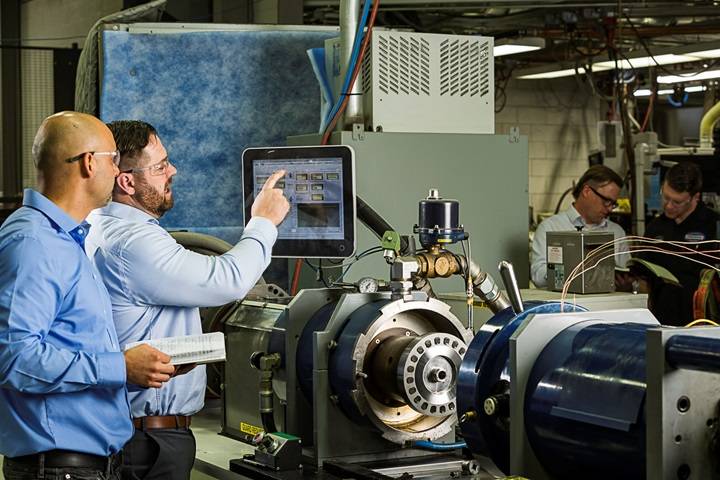
In next-generation flexographic presses, automatic pressure control is no longer an option reserved for a few, but a technological standard for those who want to compete on quality and efficiency.
Machines designed with this logic make it possible to:
integrate pressure control with other automated systems,
create repeatable and scalable workflows,
support increasingly complex production with margins under control.
The importance of automatic pressure control on flexographic printing presses goes far beyond visual quality improvement. It is a strategic lever that affects productivity, costs, reliability, and industrial competitiveness.
In a market where flexographic printing must respond to increasingly variable demand and tighter timelines, relying on automatic pressure-control systems means moving from reactive management to a truly governed industrial process.
For those investing in flexographic technology today, this is not a technical detail, but a decision that determines plant value over time.
Ofem: Your Partner in Flexographic Printing
We will be happy to answer any questions you may have and help you best meet your needs.
How we will support you:
- Always attentive to the customer
- Ready to serve you best
- Over ten years of experience
- Results-oriented
- Problem solving at its finest
- Transparent consultancy
What happens next?
Let’s arrange a no-obligation phone call
We plan one or more meetings either on site or online
We will prepare a no-obligation proposal for you
Book a Free Consultation
FAQ
Editorial Q&A
Q: What is the most common mistake when evaluating The Importance of Automatic Pressure Control on Flexographic Printing Presses?
A: The most common mistake is evaluating only the purchase price and ignoring setup time, waste, and process consistency.
Q: How can we measure whether The Importance of Automatic Pressure Control on Flexographic Printing Presses is improving production performance?
A: Track startup waste, stable-speed output, repeatability across jobs, and intervention rate by operators.
Q: When does The Importance of Automatic Pressure Control on Flexographic Printing Presses become a strategic investment and not only a technical upgrade?
A: It becomes strategic when quality remains stable over time and process variability decreases across shifts.
Q: Which technical checks should be completed before scaling The Importance of Automatic Pressure Control on Flexographic Printing Presses?
A: Validate substrate behavior, registration stability, downtime causes, and maintenance windows under real workloads.
Q: How do we keep The Importance of Automatic Pressure Control on Flexographic Printing Presses reliable after go-live?
A: Use a recurring checklist, assign clear ownership, and review machine and process KPIs on a fixed cadence.