
Flexographic printing is now one of the pillars of industrial production for packaging, labels and flexible materials. Not because it is “fashionable”, but because it responds in a concrete way to three key needs of modern industry: production speed, cost control and constant quality over large volumes.
In recent years, the evolution of industrial flexographic printing machines has transformed this technology into a strategic tool to increase competitiveness and profitability, overcoming the limits of traditional printing and adapting to increasingly dynamic markets.
What is flexographic printing and why does it dominate the packaging industry
Flexographic printing is a rotary printing process that uses flexible photopolymer clichés, capable of transferring ink onto a wide range of media: plastic films, paper, cardboard, paired materials and technical substrates.
The reason industrial flexographic printing has become dominant is simple:
it runs continuously,
it reaches high production speeds,
it ensures repeatability and colour consistency,
drastically reduces waste and downtime.
In an industrial context where every minute and every meter printed affects margins, these factors make the difference.
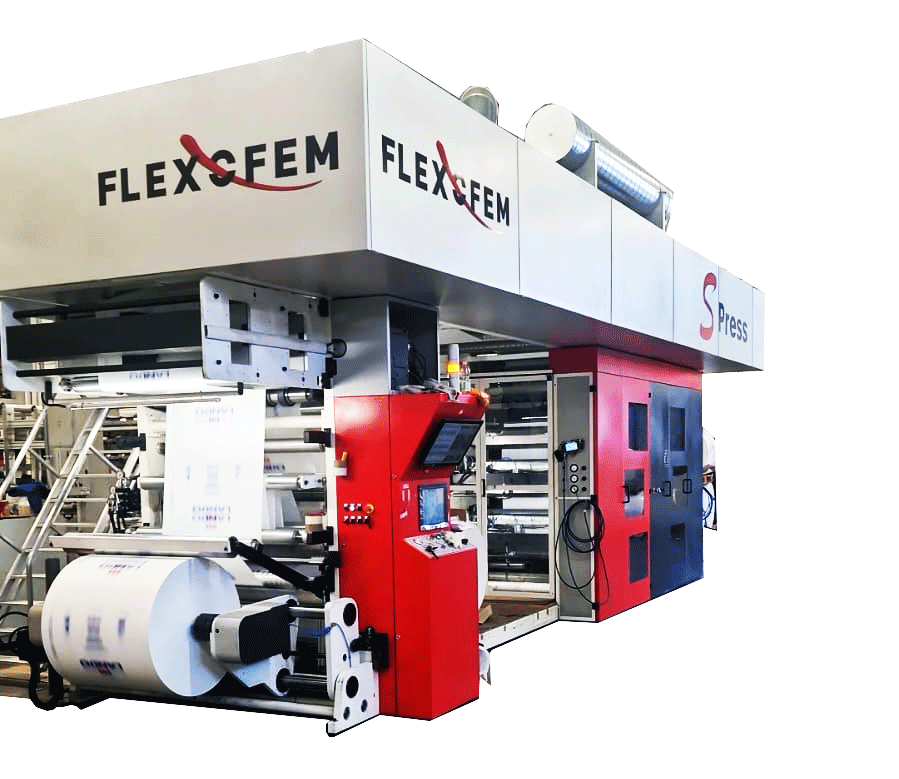

Flexographic printing machines: the three main architectures
- Flexographic central drum (CI) printers
- Modular flexographic presses (in-line)
- Flexographic stack printers
Flexographic Presses: Insight into the 3 Main Architectures
When discussing flexographic machines, there is no universal solution. The right choice depends on product type, substrate, and production objectives. The three main architectures are:
1. Central-drum flexographic presses (CI)
CI (Central Impression) machines use a shared central drum where the substrate remains continuously supported during printing.
Main advantages:
extremely stable register,
high quality even on thin films,
ideal for flexible packaging and high-speed production.
They are the preferred choice when the priority is consistent quality on large print runs.
2. Modular flexographic presses (in-line)
Modular machines are configured with independent print units that can be combined with additional processes such as coating, lamination, or die-cutting.
Main advantages:
maximum production flexibility,
machine layout customization by job requirement,
integration of multiple processes in a single line.
They are ideal for companies that handle different products and variable lot sizes.
3. Stack flexographic presses
In stack machines, print units are arranged vertically and operate independently.
Main advantages:
immediate accessibility to print units,
simple setup configuration,
excellent performance on paper, cardboard, and labels.
They are often selected for structured production with clear and repeatable operational requirements.

One of the elements that revolutionized modern flexographic printing is the introduction of gearless technologies, which eliminate mechanical gears in favor of electronically controlled independent motors.
This approach enables:
greater register accuracy,
vibration reduction,
less mechanical maintenance,
faster setup and job changeover times.
The result is more stable, efficient, and predictable production, with a direct impact on profitability.
Why flexographic printing really improves profitability
The increase in profitability does not come only from print speed. The real economic benefits come from:
reducing waste,
shorter setup times,
production continuity,
integration of multiple processes into a single machine,
long-term reliability.
A well-configured flexographic machine becomes an industrial asset that works in a constant, predictable, and scalable way.
In the current industrial landscape, flexographic printing is not just a printing technology, but a tool for production optimization and economic growth.
Choosing the right flexographic printing press means investing in the quality, efficiency, and sustainability of your industrial model. When technology is designed around real production needs, the result is measurable: more competitiveness, more control, more profitability.
Net profitability improvement:
Are you ready to increase competitiveness in the packaging industry?

Ofem: Your Partner in Flexographic Printing
We will be happy to answer any questions you may have and help you best meet your needs.
How we will support you:
- Always attentive to the customer
- Ready to serve you best
- Over ten years of experience
- Results-oriented
- Problem solving at its finest
- Transparent consultancy
What happens next?
Let’s arrange a no-obligation phone call
We plan one or more meetings either on site or online
We will prepare a no-obligation proposal for you
Book a Free Consultation
FAQ
Editorial Q&A
Q: What is the most common mistake when evaluating How to choose an industrial flexographic printing press?
A: The most common mistake is evaluating only the purchase price and ignoring setup time, waste, and process consistency.
Q: How can we measure whether How to choose an industrial flexographic printing press is improving production performance?
A: Track startup waste, stable-speed output, repeatability across jobs, and intervention rate by operators.
Q: When does How to choose an industrial flexographic printing press become a strategic investment and not only a technical upgrade?
A: It becomes strategic when quality remains stable over time and process variability decreases across shifts.
Q: Which technical checks should be completed before scaling How to choose an industrial flexographic printing press?
A: Validate substrate behavior, registration stability, downtime causes, and maintenance windows under real workloads.
Q: How do we keep How to choose an industrial flexographic printing press reliable after go-live?
A: Use a recurring checklist, assign clear ownership, and review machine and process KPIs on a fixed cadence.