
Well, when you’re talking about industrial flexographic printing, the choice of machine architecture is a strategic decision that directly affects productivity, quality and operational flexibility. Among the different configurations available, the flexographic stack printer continues to represent an extremely valid solution for many industrial applications, especially when simplicity, accessibility and reliability are concrete priorities.
Understanding why a stack flexographic press is worth choosing means going beyond theoretical definitions and analysing how this architecture responds to real day-to-day production needs.
What is a flexographic stack printer
The flexographic stack machine is characterized by print groups arranged vertically, one above the other. Each group is independent and works on its own cylinder, allowing direct and intuitive management of the printing process.
This configuration is historically appreciated for its robust mechanical construction, ease of intervention and clarity of the layout, elements that make it particularly suitable for structured and repetitive production contexts.
Accessibility and operational simplicity
One of the main reasons why many companies choose a flexographic stack printer is the high accessibility to print groups. Each unit is easily accessible by the operator, making it easier and faster:
change cliché,
operational adjustments,
ordinary cleaning and maintenance operations,
control during production.
This feature reduces unproductive times and makes the process less dependent on highly specialized skills, favoring a smoother management of work shifts.
Reliability and stability over time
Flexographic stack machines are known for their solid and proven mechanical structure. In many industrial contexts, where operating conditions are demanding and production cycles are continuous, this reliability is a determining factor.
A simple and well-designed structure makes it possible to:
reduce vibration,
maintain good print stability,
guarantee consistent long-term performance.
For companies running continuous production, mechanical reliability translates into less machine downtime and greater production continuity.
Versatility on materials
The flexographic stack printer adapts very well to printing on a wide range of substrates, especially:
paper and cardboard,
medium-rigid materials,
medium-thickness plastic films,
substrates used for labels and packaging.
This versatility makes the stack configuration a balanced choice for companies handling multiple product types that need stable performance across different materials.
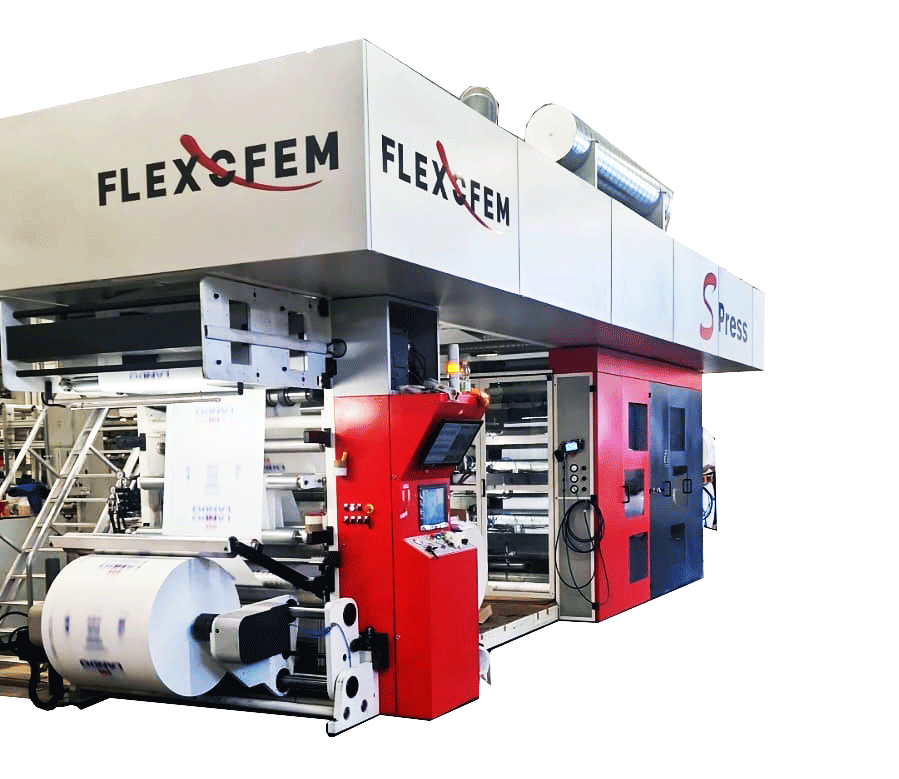
The stack architecture gives operators immediate visual and operational control over each printing unit. This enables rapid intervention when quality changes occur, preventing small issues from spreading along production.
From an industrial perspective, this means:
greater responsiveness,
waste reduction,
better management of print tolerances.
Direct control is especially valuable in production where quality must be monitored continuously and the process must stay under control at every stage.
Efficiency in structured production contexts
The flexographic stack machine reaches maximum effectiveness in well-organized production environments, where:
jobs are relatively standardized,
format changes are not excessively frequent,
process stability is the priority.
In these cases, architectural simplicity helps optimize workflows and achieve high real productivity, without the management complexity of more articulated systems.

When a flexographic stack machine is the right choice
- is mainly printed on paper, cardboard or medium-rigid materials
- requires fast accessibility to print groups
- production is continuous and structured
- reliability over time is a priority
- you want a solid, clear and easy to govern machine
Compared to other architectures, the flexographic stack printer can offer:
a more contained initial investment at equal configuration,
maintenance costs generally more predictable,
less complex operational management.
This makes it particularly interesting for companies looking for a balance between performance, reliability and total cost of exercise, without sacrificing print quality.
Why switch to STACK in the industry?
STACK: a strategic choice in industrial flexographic printing

The next generation flexographic stack machines have exceeded many of the limits of the past thanks to:
digital control systems,
more precise adjustments,
integration with process automation,
better management of print parameters.
This makes them perfectly competitive even in modern industrial contexts, where quality, efficiency and control must live together.
Choose a flexographic stack printing machine means focusing on reliable technology, accessible and suitable for structured industrial production. It is not the right solution for each application, but when the production context requires it, the stack offers vantaggi concreti e misurabili in terms of operational continuity, management simplicity and print quality.
In a market where flexographic printing must ensure constant and sustainable results, flexographic stack printer remains a scelta razionale e strategica for many companies looking for solidity, control and value over time.
Ofem: Your Partner in Flexographic Printing
We will be happy to answer any questions you may have and help you best meet your needs.
How we will support you:
- Always attentive to the customer
- Ready to serve you best
- Over ten years of experience
- Results-oriented
- Problem solving at its finest
- Transparent consultancy
What happens next?
Let’s arrange a no-obligation phone call
We plan one or more meetings either on site or online
We will prepare a no-obligation proposal for you
Book a Free Consultation
FAQ
Editorial Q&A
Q: What is the most common mistake when evaluating Why Choose a Stack Flexographic Printing Press??
A: The most common mistake is evaluating only the purchase price and ignoring setup time, waste, and process consistency.
Q: How can we measure whether Why Choose a Stack Flexographic Printing Press? is improving production performance?
A: Track startup waste, stable-speed output, repeatability across jobs, and intervention rate by operators.
Q: When does Why Choose a Stack Flexographic Printing Press? become a strategic investment and not only a technical upgrade?
A: It becomes strategic when quality remains stable over time and process variability decreases across shifts.
Q: Which technical checks should be completed before scaling Why Choose a Stack Flexographic Printing Press??
A: Validate substrate behavior, registration stability, downtime causes, and maintenance windows under real workloads.
Q: How do we keep Why Choose a Stack Flexographic Printing Press? reliable after go-live?
A: Use a recurring checklist, assign clear ownership, and review machine and process KPIs on a fixed cadence.