
Drupa 2024 confirmed what had already become clear in industrial printing: flexographic presses and flexographic machinery are now at the centre of a profound transformation driven by production efficiency, process control and real return on investment.
It was not just a trade fair, but a point of convergence between technology, industrial vision and the practical needs of companies operating in packaging, labels and flexible materials.
For companies investing in flexographic printing machinery, Drupa is not an event to watch out of curiosity, but an opportunity to understand where the market is truly heading and which technological choices will keep operations competitive in the coming years.
Flexographic presses: from established technology to strategic leverage
In the landscape that emerged at Drupa 2024, flexographic printing is no longer seen as a simple alternative to traditional print, but as a mature industrial platform capable of meeting new production demands.
Modern flexographic machinery is designed to:
run at high speed without sacrificing quality,
handle increasingly complex and sustainable materials,
reduce setup time and waste,
integrate into highly automated production flows.
This shift is especially visible in how manufacturers present their solutions: fewer theoretical promises, stronger focus on measurable performance and results in real production environments.
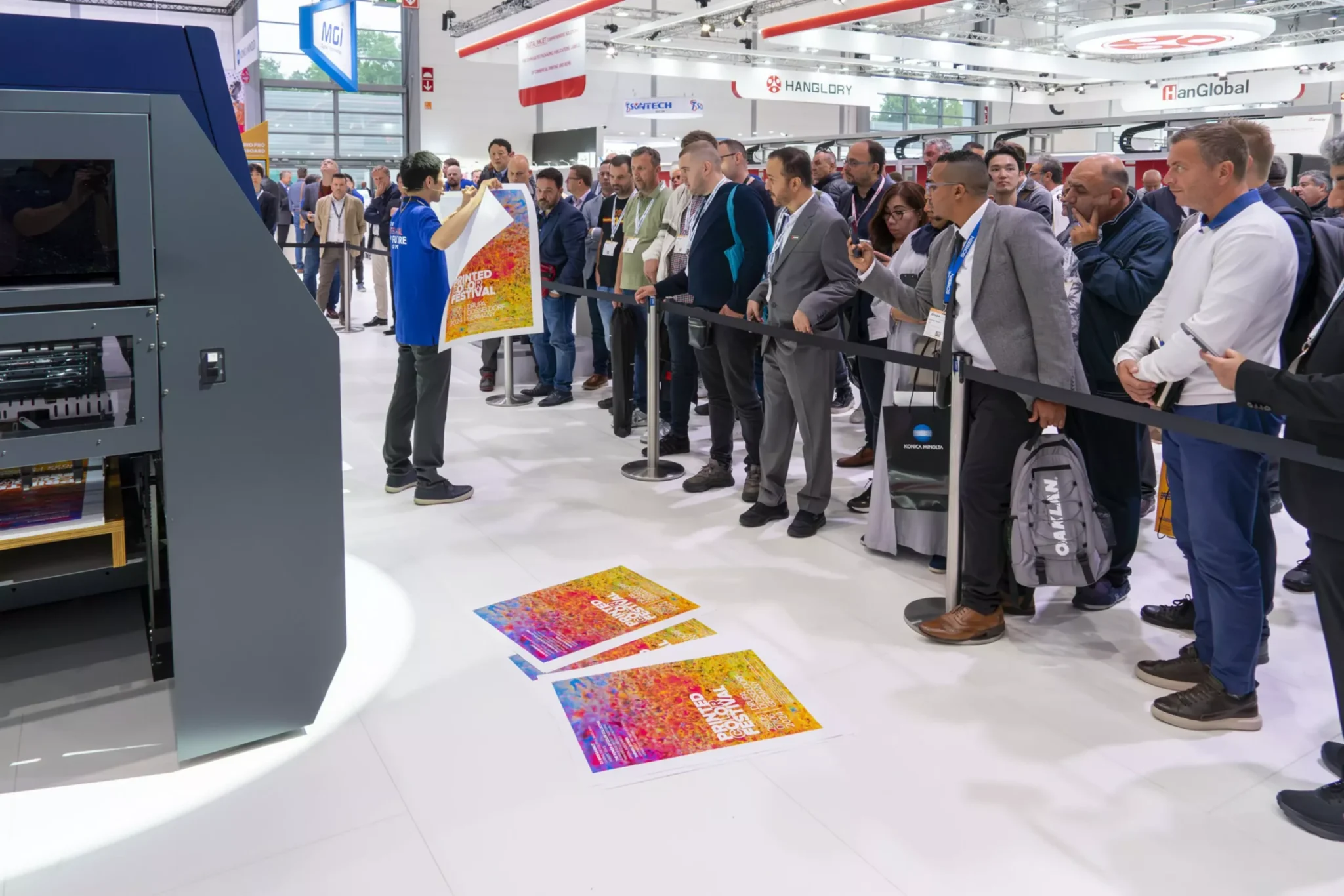
Production efficiency and process control: key themes at Drupa 2024
One of the clearest messages from the exhibition concerned the concept of print process control.
Companies are no longer looking only for fast equipment, but for a flexographic press capable of delivering stability, repeatability and predictability.
In this context, the evolution of gearless flexographic presses, central drum architectures, modular solutions and advanced stack configurations showed how technology is moving towards a precise objective: reducing uncontrolled variables.
For industrial decision-makers, this means:
less dependency on operator variability,
less rework,
fewer hidden waste costs,
greater production continuity.
This is exactly where modern flexographic printing proves its economic value.
Flexographic machinery and sustainability: an unavoidable convergence
At Drupa 2024, sustainability was not treated as a superficial topic.
Flexographic presses are now among the technologies most compatible with the evolution of sustainable substrates, thanks to their ability to print on:
recyclable films,
mono-material structures,
substrates with reduced environmental impact.
The most advanced industrial flexographic machines optimise energy consumption, reduce ink usage and limit waste during start-up. This is not only a response to regulation, but a concrete competitive lever for companies operating in markets that are increasingly sensitive to supply-chain sustainability.
Choosing a flexographic press as a strategic decision
One of the most relevant points highlighted at Drupa 2024 concerns the decision-making process of companies investing in new flexographic machinery.
Technology is no longer selected based on a single feature, but on a combination of factors:
type of materials to be printed,
current and future production volumes,
market-required flexibility,
integration potential with existing lines,
total cost of operation over time.
Within this framework, flexographic presses remain a solid choice for companies seeking a balance between performance, adaptability and profitability.
Drupa 2024 and the role of applied innovation
The innovation presented at Drupa 2024 was not innovation for its own sake.
New flexographic printing machines are designed to be:
smarter,
more connected,
easier to manage in production.
Automation, job presets, advanced digital controls and real-time monitoring systems are not there for show, but to make flexographic printing more industrial and less artisanal.
For companies running multi-shift operations or complex production programmes, this translates into greater reliability and improved production planning.
Drupa 2024 reaffirmed a fundamental concept: flexographic printing is a key technology for modern industry, but only when supported by flexographic machinery designed with an industrial vision.
Choosing a flexographic press today means investing in control, efficiency and adaptability. In an increasingly competitive market, these are not optional features, but essential requirements for sustained growth.
Ofem’s approach to flexographic machinery presented at Drupa
In the Drupa 2024 context, Ofem brought a clear vision: flexographic presses must be designed starting from the real production process, not from ideal catalogue configurations.
Whether the requirement is for:
central drum flexographic machinery for maximum stability,
modular solutions for production flexibility,
stack configurations for accessibility and integration,
the objective remains the same: to provide machines that perform reliably over time, not only during acceptance testing.
This approach is reflected in flexographic press design built to grow with the company, adapt to market changes and maintain consistent performance even under demanding production conditions.
Why Drupa 2024 truly matters for companies investing in flexography
Attending or analysing Drupa 2024 means understanding where the flexographic machinery sector is heading.
It is not about chasing the latest technology, but about making informed decisions that directly affect:
competitiveness,
final product quality,
operational efficiency,
long-term economic sustainability.
For companies evaluating the purchase or upgrade of a flexographic press, the message is clear: today, the real differentiator is the alignment between technology and production process.
Ofem: Your Partner in Flexographic Printing
We will be happy to answer any questions you may have and help you best meet your needs.
How we will support you:
- Always attentive to the customer
- Ready to serve you best
- Over ten years of experience
- Results-oriented
- Problem solving at its finest
- Transparent consultancy
What happens next?
Let’s arrange a no-obligation phone call
We plan one or more meetings either on site or online
We will prepare a no-obligation proposal for you
Book a Free Consultation
FAQ
Editorial Q&A
Q: What is the most common mistake when evaluating Drupa 2024: the future of flexographic presses is driven by efficiency, control and scalability?
A: The most common mistake is evaluating only the purchase price and ignoring setup time, waste, and process consistency.
Q: How can we measure whether Drupa 2024: the future of flexographic presses is driven by efficiency, control and scalability is improving production performance?
A: Track startup waste, stable-speed output, repeatability across jobs, and intervention rate by operators.
Q: When does Drupa 2024: the future of flexographic presses is driven by efficiency, control and scalability become a strategic investment and not only a technical upgrade?
A: It becomes strategic when quality remains stable over time and process variability decreases across shifts.
Q: Which technical checks should be completed before scaling Drupa 2024: the future of flexographic presses is driven by efficiency, control and scalability?
A: Validate substrate behavior, registration stability, downtime causes, and maintenance windows under real workloads.
Q: How do we keep Drupa 2024: the future of flexographic presses is driven by efficiency, control and scalability reliable after go-live?
A: Use a recurring checklist, assign clear ownership, and review machine and process KPIs on a fixed cadence.